


How to Protect Pressure Gauges from Overpressure and Damage
A pressure gauge is a silent but highly effective monitoring device in the factory's production line, fire protection system... In addition to measuring pressure values, a pressure gauge also provides the ability to output signals to control other devices such as pumps or to test and calibrate other pressure measuring devices.
The installation of a pressure gauge should be in accordance with the technical process, the correct application of each production line. If installed incorrectly, it can reduce the life of the pressure gauge and cause damage to the pressure gauge.
Sudden changes in pressure in the system are the cause of damage to the pressure gauge due to overpressure.
So how to choose a pressure gauge to help your gauge work better.
First, you should distinguish between the types of pressure and buy the right type of gauge according to your pressure range
Rated Pressure
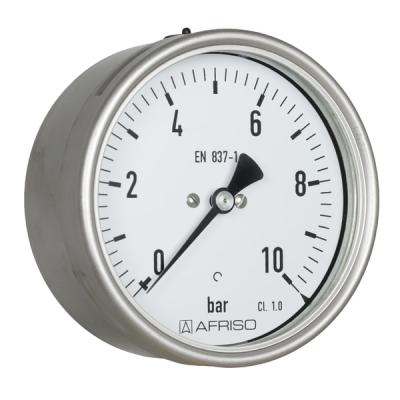
The rated pressure of a pressure gauge is the pressure range that it can accurately and safely measure. This value range is clearly displayed on any pressure gauge you buy. Electronic pressure gauges will have an upper limit printed on the dial or on a sticker, while mechanical pressure gauges have numbers on the dial.
.webp)
Actual Working Pressure
Just because a gauge can measure 6 bar, 100 bar, or any upper limit does not mean that it should always operate at or near that number. Another problem is that over time, higher pressures will wear out the internal components of the gauge and reduce its life, even if the device can technically handle those numbers.
Therefore, gauge manufacturers sometimes publish specific working pressures on their data sheets. For example, Ashcroft lists the following working pressure specifications on its 8008S gauge:
"Steady: 75% of full scale". The gauge can handle steady, steady pressures up to 75%.
"Swing: 80% of full scale". Fluctuating pressures should not normally exceed 80%.
"Short time: full scale". The gauge should not be overloaded for long periods of time
However, other manufacturers' gauges do not have this information. And the best practice is:
For example, a system with a steady pressure of 7 kg/cm2 should ideally be measured with a gauge with a measuring range of 16 kg/cm2.
Test Pressure and Overpressure
Some pressure gauges have a test pressure listed on their data plate; this is the maximum pressure the gauge can withstand without damaging the device and affecting its accuracy. Overpressure, often listed (and sometimes confused) with test pressure, is any pressure that is “beyond the full scale” of the gauge.
Gauges are not ideal when overpressured, but they will not be permanently damaged if the overpressure condition is short-lived and does not reach the test pressure. Many gauges that are moderately overpressured will return to normal once this number is reduced.
Burst Pressure
Blast pressure, like test pressure, is reported on some data plates as a percentage of the rated pressure range. However, while approaching the test pressure for a short time is acceptable, exceeding the burst pressure will always result in irreversible damage to the gauge.
Depending on the design of the gauge, the excess burst pressure may simply destroy the mechanism, or it may also cause a leak. Not all manufacturers provide the burst pressure in their data sheets because “there is no industry standard test to determine” this pressure, and it is a difficult number to estimate for gauges under different conditions.
If your system has high vibrations
If the location where the pressure gauge is installed has high vibrations, you should choose a pressure gauge with oil inside, this type of oil will prevent the gauge needle from shaking when the system starts or the system suddenly increases or decreases in pressure
Pay attention to the temperature of the system
The temperature of the system is an issue you should pay attention to. If the system has a high temperature, such as branch pipes in the boiler, or the pressure gauge is installed directly on the top of the boiler. For these locations, you should choose to buy a pressure gauge that can withstand high temperatures, and when installing, you should install a syphon tube. The function of this syphon tube is to reduce the temperature of the hot steam when entering the pressure gauge. If you buy a cheap pneumatic pressure gauge to install on the hot steam pipe, this is a bad choice. Your pressure gauge will quickly break.
Many customers ask us whether to use a pressure gauge with oil inside the gauge or a pressure gauge without oil for hot steam pipes.
When this high temperature heat enters the boudon tube, it will directly affect the oil inside the pressure gauge. After a period of use, the oil will turn yellow, reducing the clarity of the dial on the gauge. When viewing the pressure value on the gauge, you will be a bit uncomfortable because the dial is blurred. This leads to a waste of time and cost to replace the new oil for the pressure gauge. Therefore, most of the options for hot steam pipe systems will be heat-resistant pressure gauges without oil inside the gauge.
Understand the application to choose the necessary pressure gauge
Understand your application and choose the material of the pressure gauge to suit it, to help the pressure gauge work better, you can refer to the following applications
1. If your production line has a fluid of NH3, R717, if you buy a pressure gauge with a threaded connection material of brass, the NH3, R717 environment will corrode the brass material, leading to your pressure gauge being damaged quickly. Choose the right material for this application is the threaded connection material of stainless steel 316..png)
NH3 pressure gauge for R717, NH3
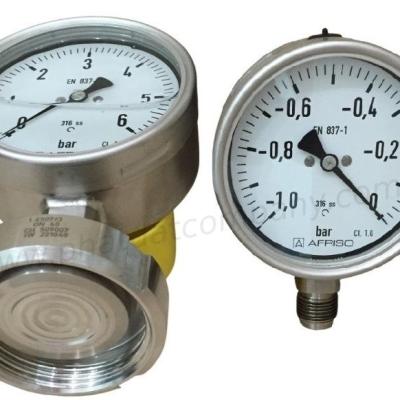
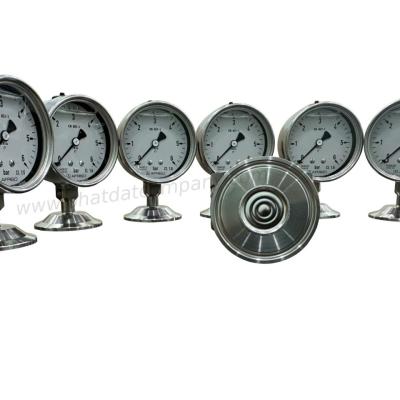
2. Your production line has fluids that are easily crystallized liquids such as milk, beer, etc., you should choose to buy diaphragm pressure gauges. Because when using a normal pressure gauge, when the milk enters the boudon tube, it will crystallize for a long time, which will clog the boudon tube. This will cause the pressure gauge to not work. Choosing a diaphragm pressure gauge in this application is the best..png)
Diaphragm pressure gauge for the beer and milk industry
3. In water supply plants. When you pump water, supply water to the tanks. You need an overpressure alarm system to turn off the water pump. This control cannot be done by conventional water pressure gauges because they only display the pressure value on the dial. The right device for this application is a 3-needle pressure gauge with electrical contacts..png)
Electric contact pressure gauge used to control water pumps
4. For pressure measurement systems that need to output a 4-20mA output signal to the inverter, PLC, pressure controller, or signal converter. Ordinary pressure gauge can only measure and display pressure value, not output 4-20mA signal. The suitable choice for this application is a pressure gauge that both displays the pressure on the dial and outputs a 4-20mA signal, also known as a 4-20mA pressure gauge.
100 mm dial
Accuracy class (EN 837-1/6) 1.0
Measuring range -1 to 0 bar, 0 to 400 bar
Operating temperature range -10 to +85 °C
Connection G½B EN 837-1/7.3, vertical
Material
Case: 304 stainless steel
Connection: 316 Ti/316 L stainless steel
Supply voltage
DC 10 – 32 V
Output signal
2 wires, 4–20 mA
.png)
5. Pressure sensors installed inside a sealed environment with stable conditions can be calibrated every 4-6 years. However, if installed outside, calibration is required every 1-4 years, depending on the ambient conditions.
Reduce the calibration interval by half if the pressure transducer has a diaphragm. This is due to increased mechanical stress from temperature fluctuations in the system or surrounding environment and the possibility of physical damage to the diaphragm.
To calibrate this pressure sensor, an indispensable tool is an electronic pressure gauge with an accuracy of 0.05%. And this type of electronic pressure gauge can also be used as a standard gauge in the calibration of spring pressure gauges and conventional water pressure gauges..png)
.webp)
Electronic pressure gauge in the calibration and inspection process
Phat Dat Company specializes in providing and installing all types of pressure gauges.
Contact phone number 02835531725, Hotline 0989286139 or e-mail: info@phatdatcompany.com
Hopefully the above article shares useful information to you. Thank you for reading the article.